Sergio Garcia

CNEG XIX Congresso Nacional de Excelência em GestãoINOVARSE – Simpósio de Inovação e Responsabilidade Social

Participe do CNEG/INOVARSE 2025: A Crise Climática e os Avanços Tecnológicos: Impactos para a Sustentabilidade das Organizações e Sociedade
 
EVENTO ONLINE Nos dias 27 e 28 de novembro de 2025, junte-se a pesquisadores, gestores e líderes de opinião em um evento totalmente online que debaterá os impactos da crise climática e os avanços tecnológicos na construção de um futuro mais sustentável. O CNEG/INOVARSE 2025 é o espaço ideal para trocar conhecimentos, apresentar estudos e fórmulas inovadoras que promovem responsabilidade social, sustentabilidade e impacto socioambiental alinhados à Agenda 2030 da ONU.

Não perca a oportunidade de fazer parte dessa discussão transformadora e contribuir para uma gestão organizacional mais sustentável e inovadora. Inscreva-se já e envie seus trabalhos científicos para enriquecer ainda mais esse debate vital!
 As apresentações de artigos científicos ocorrem ao longo dos dias 27 e 28 de novembro
em sessões temáticas online de acordo com programação a ser divulgada. 27 e 28 de novembro de 2025 Prazo para submissão de artigos: 30 de setembro de 2025
www.cneg.org

INSCRIÇÕES
https://cneg.org/inscricao/

ACESSO AO EVENTO
https://nuieventos.com.br/cneg/index.php

European Universities Competition on Artificial Intelligence to Promote Sustainable Development and Address Climate Change.

Final CallAI Competition – Submit your Project by 21 July 2025!

Call for Applications

European Universities Competition on Artificial Intelligence to Promote Sustainable Development and Address Climate Change

© AdobeStock KI

Access the AI Competition page for more details

Are you an undergraduate, master’s, or PhD student passionate about Artificial Intelligence, Sustainable Development and Climate Change? Do you want to showcase your ideas and solutions for a sustainable future? The European Universities Competition on Artificial Intelligence to Promote Sustainable Development and Address Climate Change is calling young minds from Europe to participate in this prestigious competition and contribute to shaping a more sustainable world.

Background

European universities are well placed to drive initiatives to harness the potential of Artificial Intelligence (AI) to tackle the dual crises of unsustainable development and climate change. As hubs of innovation and knowledge, they are uniquely positioned to develop AI-driven solutions that align with the UN’s Sustainable Development Goals (SDGs) and combat climate change and its related challenges. By integrating AI into research and education, universities can foster interdisciplinary collaboration and create scalable technologies.

In this context, students – as future leaders – should play an active role, especially in developing and designing new AI tools to drive sustainable transformation. Engaging students in AI for sustainability and climate change may not only help address urgent global issues. Still, it may also help to position Europe as a pioneer in ethical, impactful AI innovation, ensuring a greener, more equitable future for all.

Against this background, and as part of the Research Programme “Harnessing Artificial Intelligence for Sustainable Development and Climate Change” (HAISDCC), the Research and Transfer Centre “Sustainable Development and Climate Change Management” of the Hamburg University of Applied Sciences is organising the “European Universities Competition on Artificial Intelligence to Promote Sustainable Development and Address Climate Change”.

Objectives

The competition aims to:

  • i. Encourage interdisciplinary collaboration among students, researchers, and faculty across European universities.
  • ii. Promote the development of AI-driven solutions that contribute to the SDGs
  • iii. Highlight the role of AI in mitigating and adapting to climate change.

Structure

The competition will feature two distinct categories, each with its own focus and prizes:

Category 1: AI for Sustainable Development Projects

This category welcomes AI-driven innovations that contribute to achieving one or more of the SDGs. Solutions should leverage AI to address global challenges and foster sustainability in various domains. Key fields include:

  • Responsible Consumption & Production: AI-driven solutions for waste reduction, circular economy, supply chain optimisation, and sustainable agriculture.
  • Poverty Alleviation & Economic Inclusion: AI applications for financial inclusion, equitable access to services, and economic empowerment of marginalised communities.
  • Quality Education & Lifelong Learning: AI-driven educational platforms and intelligent tutoring systems for inclusive education.
  • Sustainable Cities & Communities: AI solutions for smart urban planning, traffic optimisation, air quality monitoring, and sustainable infrastructure.
  • Health & Well-being: AI-powered tools for public health monitoring, disease prevention, telemedicine, and access to essential healthcare services.
  • Water and Sanitation Management: AI models for water purification, distribution efficiency, and pollution detection.

Category 2: AI and Climate Change Solutions

This category focuses on AI applications that tackle climate change by supporting mitigation, adaptation, and environmental conservation efforts. Innovations should leverage AI to monitor, predict, and combat climate-related challenges. Key fields include:

  • Carbon Footprint Reduction: AI for industry energy efficiency, sustainable transportation, and carbon capture technologies.
  • Climate Modeling & Risk Prediction: AI-driven climate change impact analysis simulations, extreme weather forecasting, and long-term environmental trends.
  • Renewable Energy Optimisation: AI for smart grid management, solar and wind energy prediction, and energy storage efficiency.
  • Disaster Preparedness & Response: AI applications for early warning systems, real-time disaster tracking, and emergency response coordination.
  • Biodiversity & Ecosystem Conservation: AI for wildlife tracking, deforestation monitoring, ocean health assessment, and ecosystem restoration.
  • Sustainable Agriculture & Food Security: AI in precision farming, water-efficient irrigation, and crop yield prediction in response to climate change

Who Can Apply?

We welcome applications from undergraduate, master’s, and PhD students currently enrolled at universities in Europe who are passionate about using AI to solve sustainability and climate problems.

Students from diverse academic backgrounds are encouraged to participate, including but not limited to:

  • Computer Science & Artificial Intelligence
  • Environmental Sciences & Sustainability
  • Engineering & Technology
  • Economics, Business & Policy Studies
  • Health & Life Sciences
  • Social Sciences & Humanities
  • Education & Learning Technologies
  • Mathematics & Statistics

Why participate?

  • Gain Recognition: Present your work to an international audience of experts, policymakers, and industry leaders.
  • Win Prizes: Top submissions will receive awards, certificates, and potential funding opportunities.
  • Expand Your Network: Connect with like-minded peers, academics, and professionals.
  • Get Mentorship: Benefit from expert guidance to further refine and develop your ideas.

Application and selection process
Participation is free of charge.

Applicants: undergraduate, master’s, and PhD students currently enrolled at European universities.

Number of applicants per project: Both individual and group applications are allowed.

  • Individual applications: Solo participants can submit their projects independently.
  • Group applications: Teams of up to 3 authors can collaborate on a single project submission.

We encourage multidisciplinary teams, bringing together diverse expertise to develop innovative AI-driven sustainability and climate resilience solutions.

Project: Participants must submit a project proposal, research paper, or innovative solution that:

  • addresses one of the competition themes: AI for Sustainable Development Projects or AI and Climate Change Solutions
  • follows the established evaluation criteria
  • has a maximum of 3,000 words (excluding references)
  • Uses the official template (available here)

Submissions should present well-structured, original, and impactful AI-driven solutions contributing to sustainability and/or climate resilience.

Deadline: Applicants should submit their projects until the 21st of July 2025 at 17:00 CET via e-mail address: AI.competition (at) haw-hamburg (dot) de 

Dates

  • Launch: Announcement and call for submissions (20th March 2025)
  • Submission deadline for project proposals (21st July 2025)
  • Shortlisting: Top 10 projects in each category announced (15th October 2025)
  • Final Pitch Event: Shortlisted teams present to a panel of judges (24th November 2025)
  • Awards Ceremony: Winners announced at the European Symposium on AI for Sustainability and Cimate Change (15th January 2026)

Selection process: A panel of experts will review applications based on the established criteria presented below.

Selection criteria:

  • a) Research problem: Clarity, significance, and alignment to sustainability (Category 1) and climate change (Category 2)
  • b) Content relevance and accuracy: Accuracy of information, alignment with objectives, and correctness of supporting data/details
  • c) Organisation, clarity and visual appeal: Logical structure, ease of follow, and effective use of visuals/graphics to convey information
  • d) Methodology: Appropriateness, depth, and rigor of the methods or processes used (design, data collection, analysis, etc.)
  • e) Novelty and creativity: Origininality, innovative ideas, and creative approach to addressing the research question or problem
  • f) Impact and practical significance: Potential real-world relevance, sustainability, and broader benefits or applications

Prizes: Three prizes will be provided for each category, or six prizes in total. They entail:

  • €2,000 grand prize for the three winning projects in each category
  • Access to mentorship opportunities with leading AI and sustainability experts
  • Showcase at the European Symposium on AI for Sustainability and Climate Change to be organised in Hamburg.
  • Links with potential investors for advice on funding support for project implementation

Notification: All finalists and winners will be notified by e-mail after the judging. If you receive a notification e-mail from the organisation, you must respond to the notification e-mail to accept your shortlisting. If the organisation does not receive your response within seven (7) days of the notification, it reserves the right to reallocate the prize to another Applicant.

Final Presentation: Shortlisted candidates will be invited to present their work at the European Symposium on AI for Sustainability and Cimate Change on the 15th of January, 2026.

Partnerships
The following institutions are partners of the European Universities Competition on Artificial Intelligence to Promote Sustainable Development and Address Climate Change: 
 
UPC Barcelona Tech
University of the Aegean
Wirtschafts Hochschule Mainz
Liverpool John Moores University
Universidade Aberta
University of Zurich
University of Latvia
The Institute for Artificial Intelligence Research and Development of Serbia
Institute for Ethics in AI (IEAI), Technical University of Munich
Lisbon School of Architecture of the University of Lisbon
Vasile Alecsandri Universitiy of Bacau
Unit for Innovation and Research in Engineering (UnIRE)
National and Kapodistrian University of Athens

Eligibility

  • a) Applicants can only submit original works for which they are the sole creators and copyright holders. If a group of authors is involved, the names of all authors must be listed. This will be considered a single application for prizes and benefits under the copyright rules described below.
  • b) Applicants must describe in the submitted research proposals the research activities that are feasible, possible to achieve, and sustainable.
  • c) Applicants can only indicate their team members at the first-time submission; members can’t be added after submission.
  • d) Applications that lack personal information, including names, emails, and the number of team members, may be disqualified.
  • e) Lacking information in applications means that they are subject to disqualification.
  • f) Any missing answers will lead to disqualification.
  • g) The reviewers will not examine projects exceeding the number of words specified.

Copyright and moral rights
By submitting works to the organisation, you confirm that:

  • a) You are the author of the project, and it is your original work, and to the best of your
  • knowledge, no third party can claim any rights to the material submitted.
  • b) You are the copyright holder
  • c) In its sole discretion, the organisation reserves the right to disqualify any incomplete application that is irrelevant to the theme or does not comply with any of the terms and conditions or the organisation’s values and guiding principles.

Miscellaneous

  • a) The organisation reserves the right to cancel, modify, suspend, or delay the competition due to unforeseen circumstances beyond its control.
  • b) The organisation reserves the right to change, amend, delete or add to these terms and conditions at any time.
  • c) The organisation shall not be responsible or liable for: any problem, loss or damage, misdirected or illegible entries, delay or failure in receiving and sending the entry because of any network, communication or system interruption or error, or any error, interruption, deletion, defect, delay in operation or transmission, site failure or unauthorised access to entries.
  • d) By participating in the competition, applicatns agree that personal data, especially name and country, may be processed, shared, and otherwise used for the purposes and within the context of the competition, institutional activities, and any other purposes outlined in these terms and conditions. The organisation may also use the data to verify the applicant’s identity, postal address, and contact details or determine their eligibility to participate in the competition.
  • e) By applying, the applicant confirms that the terms and conditions for this competition, as set out above, have been read, understood, and agreed to by the applicant.

Contact us for inquiries, please email us at: AI.competition (at) haw-hamburg (dot) de

INDUSCON 2025

News

INDUSCON 2025 Will Be Hosted in São Sebastião Through Strategic Partnership with Local Government

7 de April de 2025

The organizing committee of INDUSCON 2025 held a strategic meeting with São Sebastião’s Tourism

Read More

Submissions Starting on January 15, 2025

15 de January de 2025

Read More

Towards an innovation ecosystem based on industry and academy partnership

11 de December de 2024

On behalf of the organizing team, we would like to invite you to take part in INDUSCON 2025.

Read More

Partners

face_ss

Important Dates

Submissions Open: January, 15, 2025 [OPEN]
Submissions Deadline: April 30, 2025
Accept/Reject Notification: July 1, 2025
Final Version Submission: August 1, 2025

Email

contact-2025@induscon.org

Event Location

R. Ítalo Nascimento, 366 – Praia do Porto Grande, São Sebastião – SP
CEP: 11608-248

Supported by

Fatec de São Sebastião
Etec de São Sebastião

Induscon

IEEE/IAS International Conference on Industry Applications

Previous editions

Copyright © 2024-2025 – Induscon. Todos os direitos reservados.

Acreditamos no poder do capital como motor das transformações e no papel do jornalismo como catalisador do debate.

NOVA ENERGIA

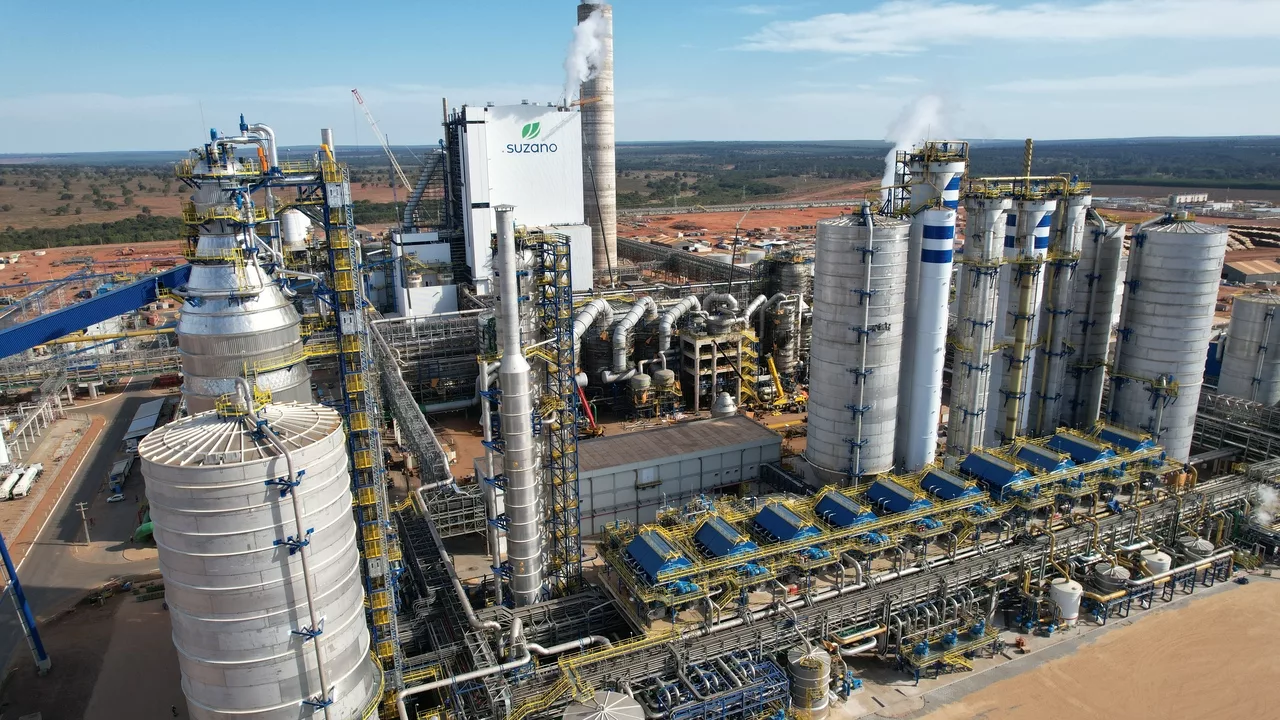
A Suzano acaba de inaugurar uma nova fábrica ‘estado da arte’, que consumiu R$ 22 bilhões e usa novas tecnologias para substituir combustíveis fósseis e vender a (muita) eletricidade excedente

Leia mais

REPENSANDO PARIS

A quatro dias do início dos Jogos Olímpicos, recuperamos uma reportagem do Reset de 2023 que conta a transformação de Paris em uma ‘cidade de 15 minutos’

Leia mais

CASO VOCÊ TENHA PERDIDO

Em captação de R$ 94 bi, CCR emite ‘bonds de transição’ de R$ 500 mi


Submission Invitation – DIRETRIZES PARA IMPLANTAÇÃO DE SISTEMA DE GESTÃO AMBIENTAL EM IES

Equipe editorial do International Journal of Professional Business Review (JPBReview) leu seu artigo “DIRETRIZES PARA IMPLANTAÇÃO DE SISTEMA DE GESTÃO AMBIENTAL EM IES” apresentado no congresso ” XXV Simpósio de Engenharia de Produção (SIMPEP): Inovação E Sustentabilidade Na Gestão De Processos De Negócios”.

Considerando a relevância deste congresso na sua área de conhecimento, e a qualidade do seu trabalho, convidamos você a submeter seu artigo em nossa revista.


Dear authors,

The editorial team of the International Journal of Professional Business Review (JPBReview) read your article “DIRETRIZES PARA IMPLANTAÇÃO DE SISTEMA DE GESTÃO AMBIENTAL EM IES” presented in the congress “XXV Simpósio de Engenharia de Produção (SIMPEP): Inovação E Sustentabilidade Na Gestão De Processos De Negócios”. Considering the relevance of this congress in your knowledge area, and the quality of your work, we invite you to submit your article in our journal.

Once submitted, your article will be evaluated by external reviewers and, if approved, you’ll be required to pay a publication fee of $250 (American dollars). This fee includes registration of the article’s individual DOI, text fomatting, database indexing and publication certificate. The review process of your submitted article takes approximately 10 working days.

Our journal is published by Open Access Publications, headquartered in Florida, United States of America and is indexing: Scimago Q4, Redalyc, Latindex, and others. On Google Scholar our articles have more than 5,500 citations, with H Index = 26 and i10 Index = 162.

To find more about our journal and submit your paper, please visit the website below: https://www.openaccessojs.com/JBReview

Best regards,

Editorial Team

International Journal of Professional Business Review

Parabenizamos membros do Mestrado Profissional em Sistemas de Gestão UFF/MSG pelo convite a submissão no Periódico Internacional International Journal of Professional Business Review (JPBReview)

DIRETRIZES PARA IMPLANTAÇÃO DE SISTEMA DE
GESTÃO AMBIENTAL EM IES

Publicado no XXV Simpósio de Engenharia de Produção (SIMPEP): Inovação E Sustentabilidade Na Gestão De Processos De Negócios (2018)

Autores:
ALESSANDRO GARCIA DE CASTRO – garciadecastro@gmail.com
UNIVERSIDADE FEDERAL FLUMINENSE – UFF

OSVALDO LUIZ GONÇALVES QUELHAS – osvaldoquelhas@id.uff.br
UNIVERSIDADE FEDERAL FLUMINENSE – UFF


ANDRÉ CANTARELI DA SILVA – andrecantareli@id.uff.br
UNIVERSIDADE FEDERAL FLUMINENSE – UFF


MARCIUS HOLLANDA PEREIRA DA ROCHA – marciusr@ig.com.br
UNIVERSIDADE FEDERAL FLUMINENSE – UFF


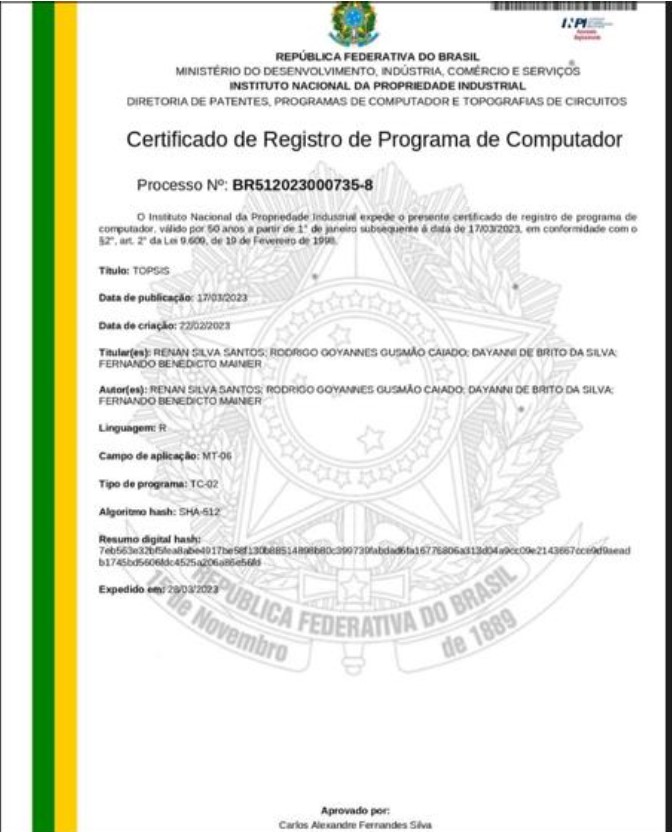
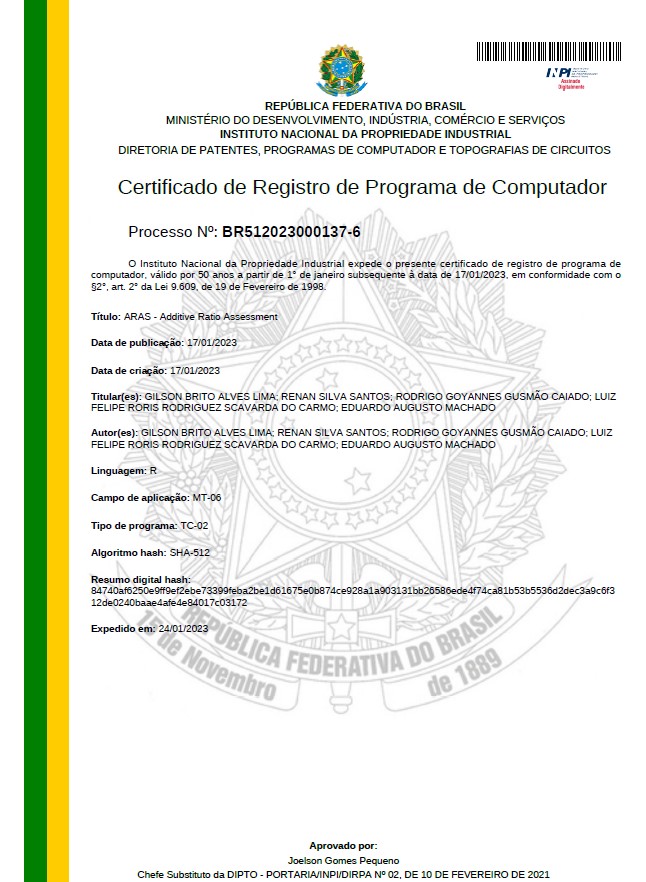
Certificado de Registro de Programa de Computador

É com satisfação que comunicamos o Certificado de Registro de Programa de Computador, junto ao Instituto Nacional da Propriedade Industrial – INPI: ARAS – Additive Ratio Assessment, fruto da parceria entre Renan Silva Santos, egresso do Mestrado em Sistemas de Gestão – MSG/UFF e os professores Gilson Brito Alves Lima,  Rodrigo Goyannes Gusmão Caiadodo Mestrado Profissional em Sistemas de Gestão MSG/UFF, e Luiz Felipe Roris Rodriguez Scavarda do Carmo, da PUC – RIO.

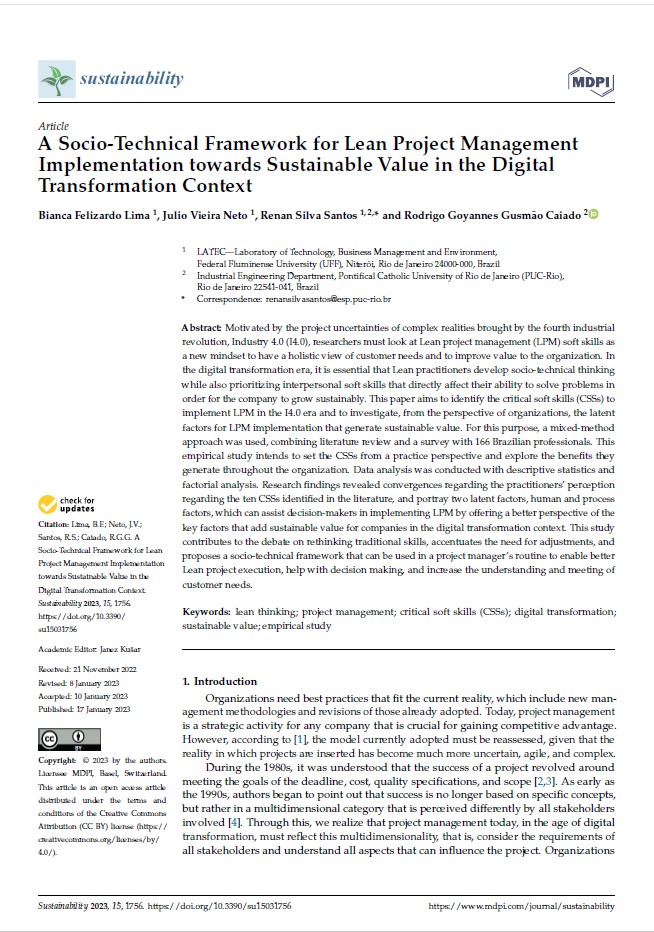
A Socio-Technical Framework for Lean Project ManagementImplementation towards Sustainable Value in the DigitalTransformation Context

Parabenizamos pelo artigo científico recém-publicado na Revista Sustainability, fruto da cooperação de pesquisadores do Mestrado Profissional em Sistemas de Gestão / Doutorado em Sistemas de Gestão Sustentáveis UFF e pesquisador da PUC-Rio.

Autores:

Bianca Felizardo Lima, Julio Vieira Neto, Renan Silva Santos, Rodrigo Goyannes Gusmão Caiado.

Access at: https://doi.org/10.3390/su15031756

Real-time energy flow mapping: A VSM-based proposal forenergy efficiency

Parabenizamos membros do Mestrado Profissional em Sistemas de Gestão UFF/MSG pela publicação no Periódico Internacional

Journal of Cleaner Production (Volume 419, 20 September 2023, 137871)

 Real-time energy flow mapping: A VSM-based proposal for energy efficiency

Autores:

Leonardo Fontoura (Fluminense Federal University, Niterói, Brazil)
Daniel Luiz de Mattos Nascimento (University of Barcelona Business School, Barcelona, Spain)
Julio Vieira Neto (Fluminense Federal University, Niterói, Brazil)
Noelia Garcia-Buendia (Department of Business Organization, Marketing, and Sociology, University of Jaen, Jaen, Spain)
Jose Arturo Garza-Reyes (Centre for Supply Chain Improvement, University of Derby, UK)
Gilson Brito Alves Lima (Fluminense Federal University, Niterói, Brazil)
Guilherme Luz Tortorella (Mechanical Engineering Department, The University of Melbourne, Melbourne, Australia)
Rodrigo Goyannes Gusmão Caiado (Pontifical Catholic University of Rio de Janeiro, Rio de Janeiro, Brazil)
Marcelo Jasmim Meiriño (Fluminense Federal University, Niterói, Brazil)

O aumento dos custos de energia e a atual preocupação com as questões de sustentabilidade impactam diretamente na competitividade e sobrevivência das organizações, promovendo a busca pela melhoria contínua nos processos produtivos industriais. O presente estudo, ao identificar a ausência na literatura de modelos baseados em Value Stream Mapping e integrados com tecnologias da Indústria 4.0 que promovam melhores práticas de eficiência energética em processos industriais, propõe um novo modelo de Lean Management denominado Real-time Energy Flow Mapping. Este modelo inovador, capacita um sistema de gestão visual, digital e sustentável de todo comportamento energético em máquinas e equipamentos utilizando métricas e regras totalmente parametrizáveis. Além disso, estimular os stakeholders com a capacidade de prever e monitorar os custos de energia, bem como identificar possíveis problemas devido a mudanças no comportamento do consumo de energia nas máquinas, ajudando assim os gestores a tomar decisões de forma mais rápida e dinâmica. Como resultado, a pesquisa bibliográfica revelou 17 modelos baseados em Mapeamento do Fluxo de Valor com foco em eficiência energética, juntamente com 31 métricas agrupadas em processos energéticos, ambientais e produtivos. Após discussões pelos Focus Groups, 16 métricas resultantes foram submetidas a painel de especialistas, no qual as menos relevantes foram descartadas e as 13 mais relevantes classificadas usando Fuzzy Delphi. Uma análise para verificar as inter-relações entre as métricas é realizada utilizando o Fuzzy DEMATEL, sendo por fim aplicada no modelo proposto. Foi realizado um estudo de caso do modelo, submetendo-o operacionalmente ao LabFaber 4.0, validando empiricamente o estudo. O Mapa de Fluxo de Energia em Tempo Real preenche a lacuna na literatura sobre modelos de Mapeamento do Fluxo de Valor para melhorar a eficiência energética, monitorando o consumo de energia por meio do mapeamento dinâmico do fluxo de energia dos processos produtivos, identificando a área com maior potencial de economia de energia por meio de mudanças no comportamento operacional que reduzem o consumo geral de energia e os impactos ambientais.

Para mais detalhes:

https://doi.org/10.1016/j.jclepro.2023.137871

https://www.sciencedirect.com/science/article/pii/S0959652623020292?via%3Dihub

Portuguese EnglishFrenchSpanish